Sunday, July 26, 2009

Ducati Sport 1000S


Make Model

Ducati Sport 1000S Limited Edition

Year

2007 (Production 90 US Only)

Engine

Air cooled, four stroke, 90°“L”twin cylinder, DOHC, desmodromic 4 valve per cylinder.

Capacity

992
Bore x Stroke 94 x 71.5 mm
Compression Ratio 10.0:1

Induction

Marelli electronic fuel injection, 45mm throttle body

Ignition / Starting

Marelli electronic / electric

Max Power

67.7 KW 92 hp @ 8000 rpm

Max Torque

9.3 kg-m 67.3 lb-ft @ 6000 rpm

Transmission / Drive

6 Speed / chain
Frame Tubular steel trellis
Front Suspension 43mm Upside-down jelly adjustable forks, 120mm wheel travel
Rear Suspension Sachs fully adjustable monoshock on the left side 133mm wheel travel.

Front Brakes

2x 320mm discs 4 piston calipers

Rear Brakes

Single 245mm disc 2 piston caliper

Front Tyre

120/70 ZR17

Rear Tyre

180/55 ZR17
Seat Height 825 mm

Dry-Weight

179 kg

Fuel Capacity

15 Litres

Whatever you think of the new wave of retro motorcycles-faux classics to lure fashion-conscious new bikers or genuine machines with credibility and a direct line to the past-you can't ignore 'em.

And certainly nobody seemed able to ignore the Ducati Sport 1000S for the week it was in my sticky mitts. It's one of those bikes that halts pedestrians in their tracks, forces involuntary thumbs-up out of car drivers and even drags pleasantries out of well-to-do ladies on their way to beautification. It is, without doubt, gorgeous. The red paint on the bodywork and steel trellis frame is just the right shade that pops in the sun but goes bloodlike as light fades, while the proportions of the half-fairing, the chrome and ally cockpit, the simple elegance of that air-cooled 992cc engine, all add up to a visual feast.

Before over-waxing lyrically, I'll steady up; Ducati has rationalized the entire Sport Classic range around the "cooking" GT1000 base, introduced last year. So the single-sided swingarm and shock are gone, replaced with twin fully adjustable Sachs units and a double-sided swinger, and there's an exhaust pipe on either side now. Plus, you get to share the experience, as under that seat cowl is a pillion perch, with pegs to match.

Gone, too, is the kerchinkachinkachinka rattle of the original DS1000 engine's dry clutch, as a bath of oil now soothes the hydraulically operated plates. And while the bike's beauty is beguiling, it's really the engine that stars when you stop gawping and start riding; this is one of the easiest to use, most fluid powerplants ever. OK, it's not the strongest (you'll get around 75 horsepower at the rear wheel with 58 lb.-ft. of torque) and feels a little corked-up toward the 8000-rpm redline, but every single one of those horses can be put to good work in good order, and throttle control and delivery are perfectly dialed in.

The Sport 1000S's steering geometry and chassis are adequate for a mild canyon-carve, but the suspension on either end is more budget than brilliant with the 43mm upside-down Marzocchis in particular feeling a little turgid and unresponsive, especially under braking on the way into a corner. The pair of simple twin-piston calipers up front grip 320mm semi-floating discs and anchor the bike smartly, while Pirelli rubber matches with solid grip.

So, reassuringly you can actually ride the Sport 1000S like you mean it, and enjoy the process. Plus, a bit of time sorting the suspension and stifled motor will deliver a more involving motorcycle, which in these days of too-perfect bikes is arguably a good thing. The real kicker (and leftover from the first incarnation) is the rack-like riding position due to the stretch to those clip-on bars; your wrists will never forgive you, and around town the bike is pure, tortuous misery. But maybe you do have to suffer a little for fashion after all.

Suzuki Biplane Concept news


The Suzuki Biplane motorcycle that was on display at the Tokyo Auto Show was inspired design-wise by the classic Wright Brothers biplane, but I personally think it looks more like that red mean machine that Akira rode in the groundbreaking anime by Katsuhiro Otomo. Will there be secret wings hidden inside this beast? Probably not, but chances are you'll be able to fly in this thing and put just about any other vehicle on the road to shame with your speed.

Suzuki Boulevard C109R Review


Make Model

Suzuki Boulevard C109R

Year

2008

Engine

Liquid cooled four stroke, 54° V-Twin

Capacity

1786
Bore x Stroke 112 X 90,5mm
Compression Ratio 10.5;1

Induction

EFI, 2X 56mm throttle bodies

Ignition / Starting

Digital transistorized / electric

Max Power


Max Torque


Transmission / Drive

5 Speed / shaft

Front Suspension

Telescopic, coil spring, oil damped

Rear Suspension

Link type, coil spring, oil damped, adjustable spring preload

Front Brakes

2x 310mm discs 2 piston calipers

Rear Brakes

Single 274mm disc 2 piston caliper

Front Tyre

150/80R16

Rear Tyre

240/55R16

Seat Height 710 mm

Dry-Weight


Fuel Capacity

19 Litres 5.0 gal


Suzuki presents the Boulevard C109R as the motorcycle that takes cruising to a new level which brings power in the palm of our hands and comfort for our backs and feet. You can easily understand where comfort comes from by looking at the pictures, but check out the technical features, especially the part where the GSX-R fuel injection system is being mentioned, and form your own opinion on this classic cruiser.

Suzuki launched the Boulevard C109R as the classic tourer which will complete the Boulevard line of cruisers.

Being brand new and introduced as a 2008 model, it is obvious that history isn’t its strong point but you should never doubt the quality of a Suzuki motorcycle. It doesn’t have any history but who says it doesn’t benefit of Suzuki’s championship winning GSX-R fuel injection systems which make it unique in the disputed market of cruisers, especially in the U.S.

Conclusions can be easily drawn but the most reflecting is that history is being written at Suzuki’s with their new model always ready to head on the freeway.

Suzuki did present the C109R as THE machine to ride in your future years of cruising and their affirmations were indeed based on the reliable package that they had to offer.

But did they take into consideration the models offered by the competition? By mentioning the competition of this model, I am referring to the Honda VTX1800R, a motorcycle with some time on the market. Retro is indeed the look for this timeless V-twin featuring classic, deeply valanced fenders, cast aluminum wheels and staggered dual exhaust. I believe that the Honda was strongly taken into consideration as Suzuki’s classic cruiser ended up featuring the same characteristics but fairly improved.

Kawasaki also has a classic cruiser to send in the battle and it is known as the Vulcan 2000 Classic, a machine that combines traditional cruiser style with modern muscle and awesome physical presence.

With strong competition coming from Honda and Kawasaki, the Suzuki reserves some surprises out on the open road and I am eager to see them.

What I most like about this cruiser it the fact that in ended up being as massive as it could get. I mean, would you like to see it looking and saying something else? I certainly don’t! I love to see a strong and dour fork sustaining a gigantic front wheel featuring dual disc brakes. I enjoy a wide seat sustained by a rigid but yet strongly-developed chassis on which is positioned the beautifully curved fuel tank.

The C109R establishes its own identity with its styling. It has pullback handlebars, floorboards that let you kick your feet out, a spacious, relaxed riding position and its own slash-cut mufflers.

But you couldn’t do that on a smaller, sleeker cruiser, wouldn’t you? That is why this motorcycle followed the recipe used when creating its engine: “bigger is better”. The result is the incredibly imposing machine implementing smooth, classic lines all the way from the fuel tank, through the seat and rear fender.

The aspect that attracted me the most on the new Boulevard and the key to C109R’s performance is its 109 cubic inch engine with Suzuki fuel injection which is the same basic powerplant used by the awesome M109R, which traces its technological heritage to Suzuki’s championship winning GSX-R supersport bikes. One ride on the C109R and you’ll notice that it boasts its own power characteristics, with more torque down low for extraordinary acceleration. I have to say that it is more than you would expect from an imposing cruiser even for its 1783cc engine.

But being imposing involves weight and you might expect to encounter this problem on the 2008 C109R. I am not saying that the machine is light as a FZ6 and I have to admit that despite featuring Suzuki Composite Electrochemical Material, it remains rather heavy and hard to maneuver at low speed. But hey, it wouldn’t be a cruiser if it was ready to receive in its saddle an 18 years old rebel.

The good news is that pounds seem to fly off as the throttle is being widely opened and the sound of the exhaust becomes a screaming monster. This is where the fun begins. Out on the freeway is where the Boulevard C109R proves its best and its owner or rider benefits of the best treatment ever. I believe that if this cruiser would be a medicine in the pharmacy, it would have been found on the distress shelf. It is that awesome!

An important factor that gives this bike a special something is the way it handles on sinuous lonely roads. The maneuverability is quite amazing and the rush given is one of a kind. I really had to experience on my own skin before I made a statement and I admit, it is wonderful to have this amount of torque available together with the comfortable riding position.

Another element very important when cruising is the suspension system which has a “must” positioned before the “providing comfort” words. At least this is what I noticed during my 200 miles ride with a cruiser that delivered me as fresh as a new born, smile on the face included. The seat had probably very much to do with the actual result but the idea is that you will never get tired or bored riding the C109R.

YAMAHA BIKES


The Yamaha YZF1000R Thunderace is a motorcycle produced by Yamaha from 1996 until 2003.The motorcycle is powered by Yamaha's 1002 cc 20-valve forward-slanting liquid-cooled four-cylinder engine. It is equipped with downdraught carburettors, throttle position sensor, gear position sensor, and a torque-boosting Exup system for low to mid-range performance with a claimed 145 bhp at 10,000 rpm and a top speed is of over 160 mph.


Manufacturer
Yamaha
Production
1996-2003
Predecessor
Yamaha FZR1000
Class
Super bike
Engine
1,002cm3 Liquid cooled 4-stroke DOHC 20 Valve[1]
Transmission
Constant Mesh 5-Speed
Wheelbase
1430 mm
Dimensions
L 2085 mm W 740 mm
Seat height
795 mm
Weight
417 lb (198 kg) (dry), ) (wet)
Related
Yamaha YZF600R
Similar
Honda FirebladeYamaha R1Yamaha YZF750.

SUZUKI HAYABUSA REVIEW


CRAZYAUTOS.BLOGSPOT.COM The Suzuki Hayabusa (also known as the GSX1300R in some countries) is a hypersport motorcycle originally introduced by Suzuki in 1999. It has a 1340 cc (81.7 cu in) inline-4 engine and was consistently tested as the fastest production motorcycle in the world before the 2001 detuning agreement referred below.The 2008 model has a MSRP of US$ 11,999.The name Hayabusa translates directly from the japanese as Peregrine Falcon, the bird capable of achieving speeds over 200 mph (322 km/h) -- and predator of (perhaps not coincidently) the common blackbird. The name is a subtle reference to Honda's competing Hawk models. When introduced in 1999, it overtook the Honda CBR 1100XXSuper Blackbird as the fastest production motorcycle. The first generation of the Hayabusa was called the GSX1300R and was powered by a 1299 cc (79.2 cu in) inline-4 liquid-cooled engine. It remained relatively unchanged up through the 2007 model year.From its debut in 1999 to June 2007 over 100,000 Hayabusas were sold worldwide.Every biker have a dream of riding Hyabusa because of the magic of the bike.Its became a passion to lots of people specially for youngsters.
The motorcycle in stock form was capable of the following performance:
1/4 mile (402 m): 10.02 seconds @ 143.7 mph (231 km/h)
60–80 mph: 3.13 seconds
80–100 mph: 3.31 seconds
Top speed: 189.6 mph (305 km/h)
Power: 156.1 hp (116.4 kW) @ 9,500 rpm (rear wheel)

Absolute Cycle Performance and Lombardi Road Racing School-NYC


The Lombardi School in 2007 will offer its services at the events organized by a new local club, Absolute Cycle, part of Absolute Cycle Performance LLC, long time supporter of trackday riders and racers. Last fall, Roy Cadoo, CEO of Absolute, and Marc O’Connor saw the opportunity and the need for a boutique style road racing club where weekday events, professional coaching offered by long time racers, ex racers and expert riders, along with a very reasonable number of people attending the events, should guarantee a flawless, safe and exciting day for everybody.

In such a contest after the positive feedback by everyone who attended our Basic Level in 2006, the Lombardi Road Racing School has decided to add another course, the Intermediate Level. The new class will be run by me, Alessandro Matteucci, with a format of 2 max 3 students per instructor. With this course the Rob Lombardi School’s goal is to take an intermediate rider and provide him/her with all the techniques necessary to build a solid foundation to become a smooth, consistent, elegant and yes, fast advanced rider. By focusing on such a small number of students we will be able to personalize the teaching & riding experience with different drills according to the needs of each and every students. Also, we are planning to use videos to pin point areas of improvement and accomplishments to our students.
As I have recently explained in the Absolute Forum:
******************************************************
Question:
Originally posted by tsd345

OK, I'll start......

So Alex, I plan on attending your advanced school this year, however I haven't attended the basic. Are you going to recommend that I attend the basic?
****************************************************************
Answer:

TSD345,
It really depends on your acquired technical skills. The course is for an intermediate rider: someone who comfortably rides at that level. The Basic school is specifically for someone new at the race track even though it can correct bad habits for some experienced street rider. In the Second Level I go back to certain concepts already introduced in the first course and from there I explain, practice and review in details, with each and every student, different techniques that should have a terrific impact on his/her riding skills. Now the question is: can you find a line and can you keep it through the turn? Do you accelerate enough at the exit of a turn to the point that you are really using brake-markers to deal with the next one? Ideally a rider should start with the Basic school, ride a few club events to mature and absorb what has already learned and once he/she can ride at the intermediate level take my class. At that point he/she will be able to enjoy a boost in his/her learning curve due to the fact that I tailor my teaching to his or her expertise, leveraging on the skills while working on the inabilities.
****************************************************************


Absolute Cycle “boutique style” road racing club, along with the Lombardi School and Absolute Cycle Perfomance store, offering the lowest prices in the market, are definetely going to be one the most interesting new addition in the Tri-State&Pensylvania road racing club arena in 2007.
Absolute Cycle is in Linden, NJ, conveniently located right off the NJ Turnpike and the Goethel Bridge, ph. # 1-877-382-9800

A little help for your Christmas wish list…


We can spend a nice amount of money to gain some horsepower or loose some weight.
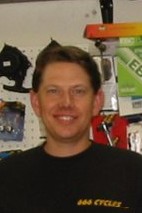
I want to share my personal experience with some nice gadgets and aftermarket high performance parts. I must admit that I love gadgets and also that I am a do-it-yourself kind of guy. I am constantly working on my own bike even if I have nothing to add or repair on it: sometimes I would just take it apart to check if everything is OK. I know …it’s insane, but I love it.
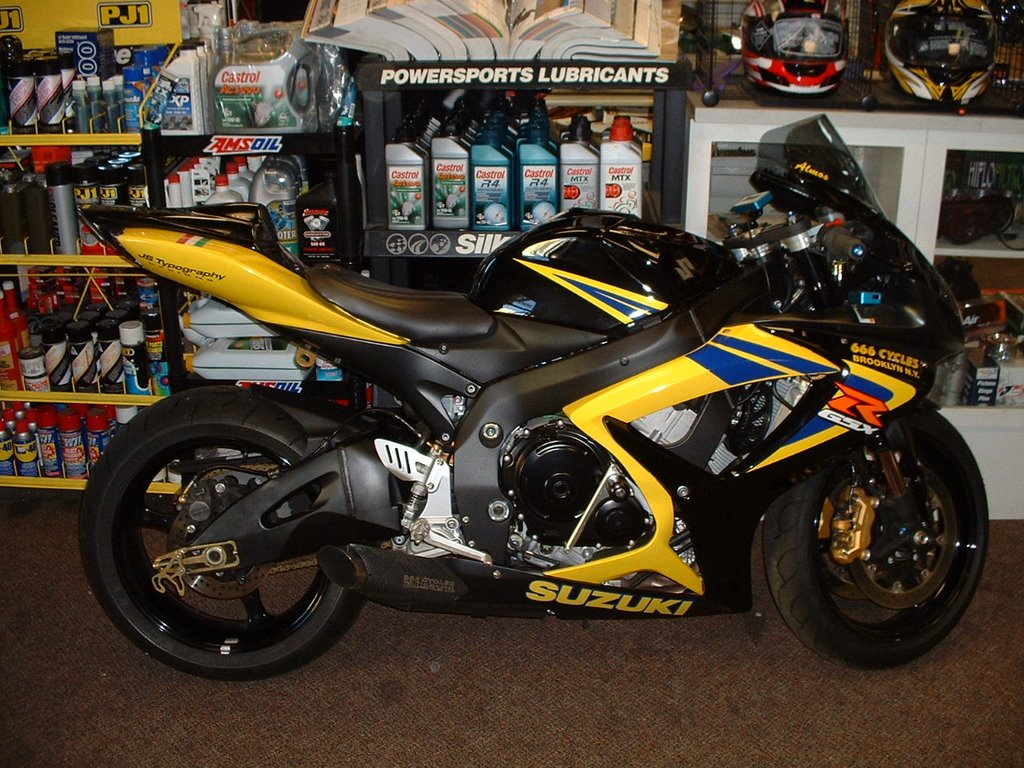
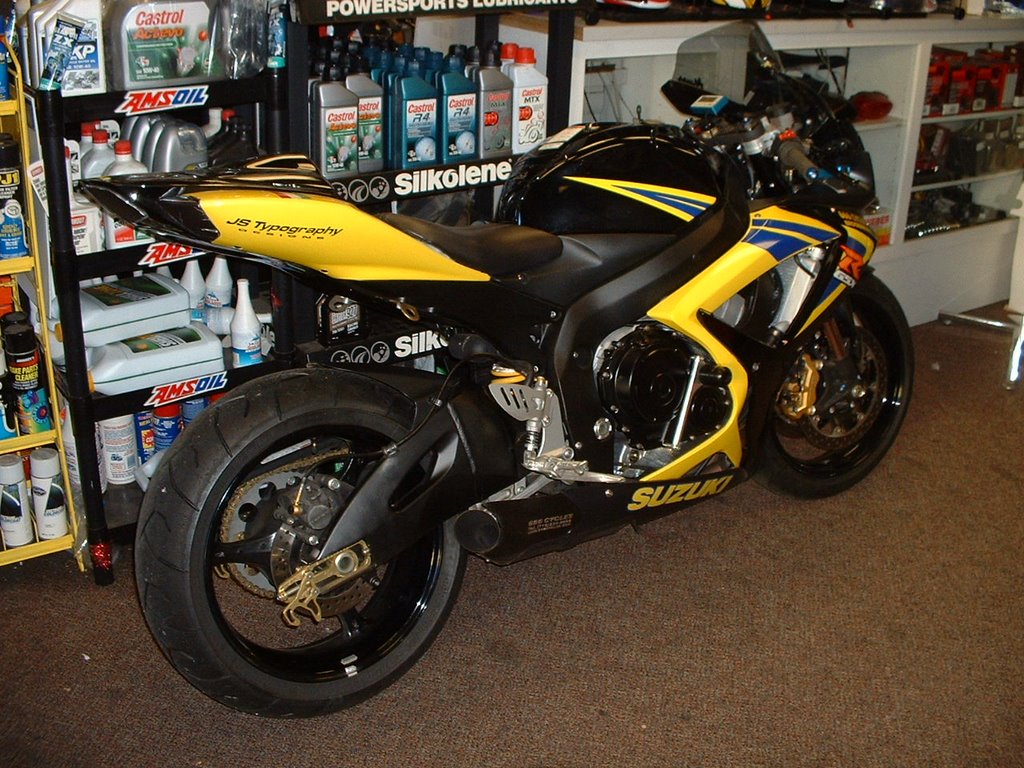
Last spring I bought a brand new 2006 Suzuki GSX-R 750 K6 , my dream bike since I saw it the first time in 1990 in a motorcycle magazine back in Hungary. I have always wanted to get a brand new bike, still in the crate, something “virgin” that nobody has ever touched besides the Suzuki factory mechanics. This year my dream finally became true!
While still waiting for it I had already planned some modifications, improvements on this otherwise awesome machine. First, I wanted to add a nice exhaust system, though the factory system is one of the best looking exhausts I’ve ever seen. This became a problem later on, since no aftermarket companies have made a nice looking one for this bike. After extensive research I have finally found a small company called TaylorMade Racing with a beatiful exhaust slip-on that saves about 12 Lbs!! The OEM system is 16 Lbs because of the strict emission and noise regulations. The TaylorMade is about 4 Lbs: you can easily figur out that it’s made of titanium. Originally I wanted to put the Yoshimura R-55 but unfortunately Yoshimura has had problems at their R&D department and they don’t have still an exhaust system for the GSX-R 750 K6 available for sale after almost 12 months.
Through out the year I have been adding parts to my baby a little bit at the time. I installed a beautiful piece of engineering, called Gilles Chain adjuster. It makes the chain adjustment easier, also a wheel change will need less effort since there are no chain adjuster blocks to fall off. Since I was already looking at the Gilles parts in my parts book, I added a titanium axle nut, it looks cool and expensive.
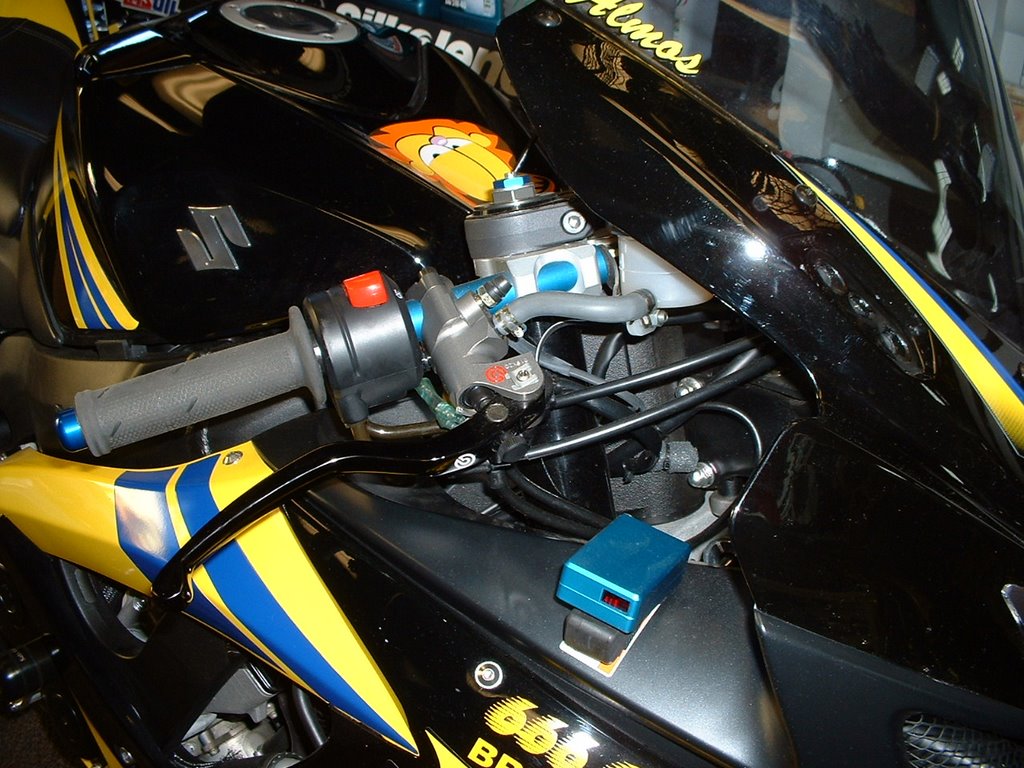
I put a nice looking and most importantly great performing billet front brake master cylinder from Brembo. This piece improved so much the braking performance of my bike that I had to use totally different brake markings on the track. It feels like you hit the wall when you squeeze it!! Now even WERA banned on its events because they give too much advantage to those who use them!! I also added a set of beautifully manufactured Spiegler stainless steel braided brake lines. These brake lines comes in a color you choose, so you can match them to your bike color !! I think it’s a nice feature and also their quality is excellent. OK, at this point it was time to make my bike faster so I added a Dynojet Power Commander III USB to reach the perfection in the fuel injection system, critical goal every time engine parts of a bike are substituted. Even on a stock bike you will feel a clear improvement in the acceleration and the throttle response with the appropriate mapping since stock bikes are tuned for low emissions and not for 100% performance.
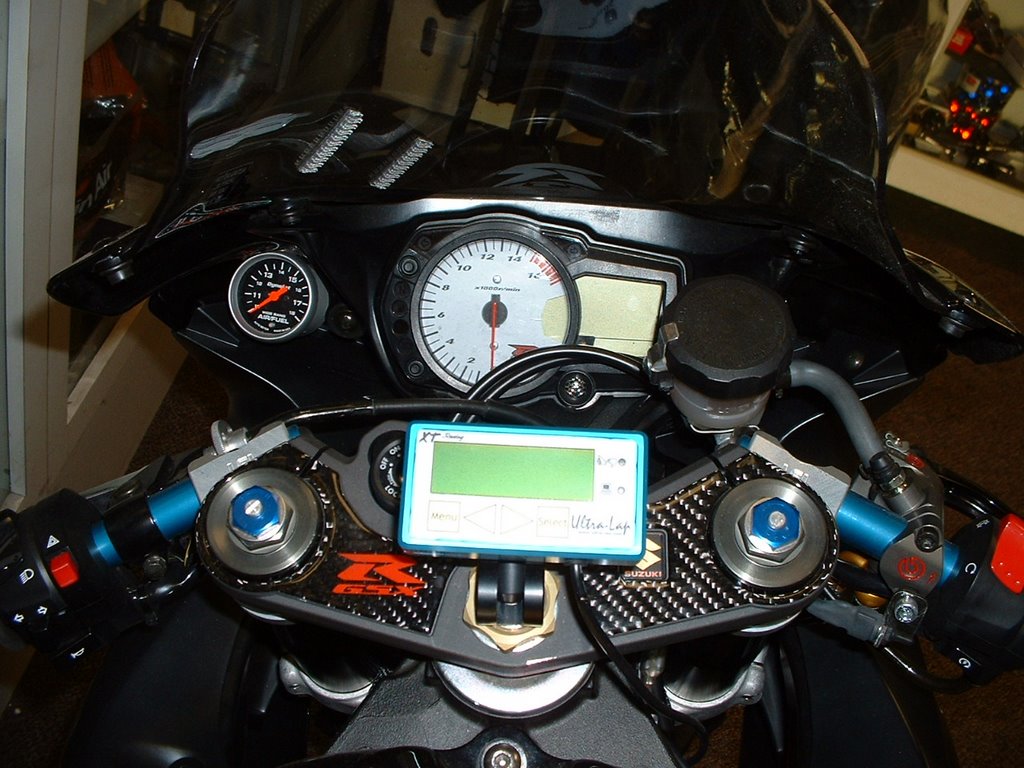
After installing the PCIIIUSB, I realized that I had to take my bike to a shop to tune it with a dynamometer. As usual, I decided to do it by myself with the help of a Dynojet Wide Band Commander, that I nick-named “pocket-dyno”. This unit can record 10 minutes of air-fuel ratio (AFR), throttle position (TP) & RPM data. After downloading the data to a laptop computer you can see the AFR compared to the TP and RPM and the PCIIIUSB can be modified to achieve the perfect AFR for the best performance. It might sounds like rocket-science, and it is!!! Don’t try this at home, let the professionals do it at a certified Power Commander dealers like 666 Cycles.
My next step was to install a set of Factory Pro velocity stacks. They give a nice, noticeable punch in the mid RPM range, smooth out the entire power band & improve the acceleration. In the same time I replaced the OEM air filter with a BMC Race air filter.
Also I let my friend Diana at Js Typography, give a custom look for the bike. She added a few blue accent stripes to help the plastic of the bike to stand out: she did an excellent job.
Since I like to travel with my bike, discover new places or just go for a weekend ride to the nearby Bear Mountain State Park, I bought a Garmin GPS receiver. It’s a great help if you just go without real destinations or you don’t want to loose time in searching for directions on a map: you want just yo hop on your bike and ride wherever you find nice twisties, without worrying to get lost. With the optional XM Traffic subscription you can avoid traffic jams or bad weather.
I also recoment another nice little gadget to whoever intends to go for gearing changes, but it’s good even on a completely stock bike: it’s called Speedohealer.
As we know, even with stock gearing the factory speedometer error can be as high as 10%, so even a modest sprocket gearing change can have the speedometer off by 15%. This little black box can calibrate the speed to almost 100% accuracy!! I have used my GPS to get my real speed and calculate the necessary adjustment on the Speedohealer.


Now, I am confident that I have contributed somehow to make your Christmas wish list a little bit longer and the need for that second mortage even more urgent ….